
Why Your Implant Ads Attract Tyre-Kickers (and How to Get Treatment-Ready Patients)
· 9 min read
If your implant ads bring tyre-kickers, that is a choice you can reverse. The targeting and qualification filter that turns cheap enquiries into treatment-ready patients.
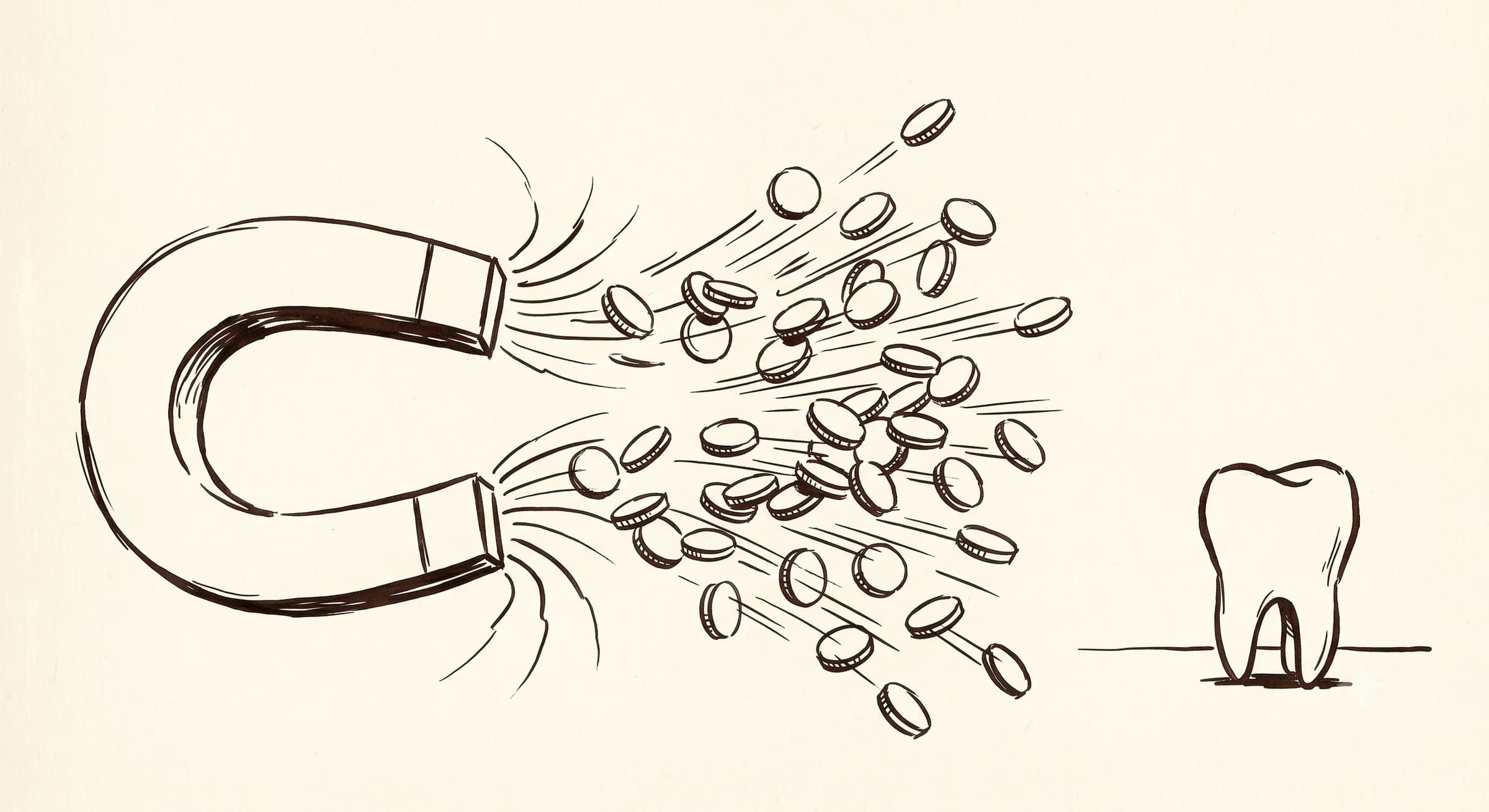
If your implant ads attract tyre-kickers, the ads are doing their job badly on purpose. Broad keywords, price-led creative, and a landing page that screens nobody all select for bargain-hunters. Tyre-kickers are a targeting and qualification choice, not bad luck. Change the filter and the same budget starts bringing treatment-ready patients instead.
That is a harder message than the one most implant marketing sells. The usual pitch is more. More leads, more enquiries, more clicks.
But an implant case is a considered, five-figure decision. A diary full of people chasing the cheapest quote in town is worse than a short list of people ready to commit.
The problem is rarely too few leads. It is the wrong ones.
The good news is that every cause of a tyre-kicker sits somewhere you control. This is where they come from. And here is the filter that screens them out before they ever waste your team's time.
Tyre-kickers are a choice, not bad luck
Price-shoppers show up because your campaign invited them. Every setting that widens the reach, drops a price into the ad, and strips friction from the form selects for people comparing five clinics on cost alone. That enquiry is not bad luck. It is the campaign working exactly as it was set up to.
Think about what a broad, price-led campaign is actually asking for, against what a filtered one asks for.
What a broad, price-led campaign asks for
- A keyword like dental implants that reaches students, browsers and bargain-hunters alike
- An ad that leads with implants from a low price, a magnet for the person who only cares about that number
- A form that asks nothing beyond a name and number, so all of them get through in one click
What a filtered campaign asks for
- Intent-led terms like implant consultation in your town, from people already shortlisting
- A page with honest price bands, so the cheapest-quote shoppers screen themselves out
- A few qualifying questions, so the wrong patient never reaches your phone
The enquiry you receive is the enquiry you designed.
None of that is the market being difficult. It is the campaign optimising for exactly what it was pointed at.
So the fix is not to work the phones harder on bad enquiries. It is to change what the campaign asks for, at four points in a row. Get those right and the wrong patient screens themselves out before you ever pay to speak to them.
Interactive · Tyre-kicker risk
How likely is your setup to attract tyre-kickers
Almost nothing is screening your enquiries, so your budget is buying whoever clicks, and on implants that means bargain-hunters. Start with the two below. They filter the most for the least effort.
Do these first
- Swap broad 'dental implants' for intent-led terms like implant consultation in your town.
- Add a negative-keyword list to strip out free, cheapest and DIY searches.
High tyre-kicker risk. Almost nothing is screening your enquiries, so your budget is buying whoever clicks, and on implants that means bargain-hunters. Start with the two below. They filter the most for the least effort.
Filter one: intent-led keywords, not broad "dental implant" traffic
The first filter is the keyword. Broad terms like "dental implants" pull researchers and bargain-hunters in alongside real buyers. Intent-led terms like "dental implant consultation" in your town, "All-on-4 cost", or "single tooth implant near me" attract people already close to a decision. You are choosing your patient before they click.
The difference is the mindset behind the search. Someone typing "dental implants" might be years away from treatment, or writing a school project.
Someone typing "implant dentist [town]" or "All-on-4 [city]" has moved from wondering to shortlisting. They are picking a clinic, not learning what an implant is. That is the search you want to be paying for.
Match your keywords to the decision, not the topic. Favour exact and phrase match over broad match, so you appear for the specific searches you chose rather than everything Google decides is loosely related.
Group tightly too. A "single tooth implant" search should land on single-tooth messaging, and a "full arch" search on full-arch messaging. The tighter the match between what they typed and what they see, the more the click is worth.
Filter two: negative keywords screen the bargain-hunters out
Negative keywords are the cheapest quality control in paid search. Adding words like "free", "cheapest", "DIY", and "finance only" as negatives stops your budget being spent on clicks that were never going to accept a five-figure case. Skip this step and a large share of your spend leaks to searches you would never have chosen to pay for.
The waste is real and measurable.
25%
On implant clicks that adds up fast. They run roughly £8 to £25 each in competitive UK areas at the time of writing in 2026. Check your own search-terms report to see what you are actually paying for, and check live click costs in Google Keyword Planner rather than trusting any benchmark.
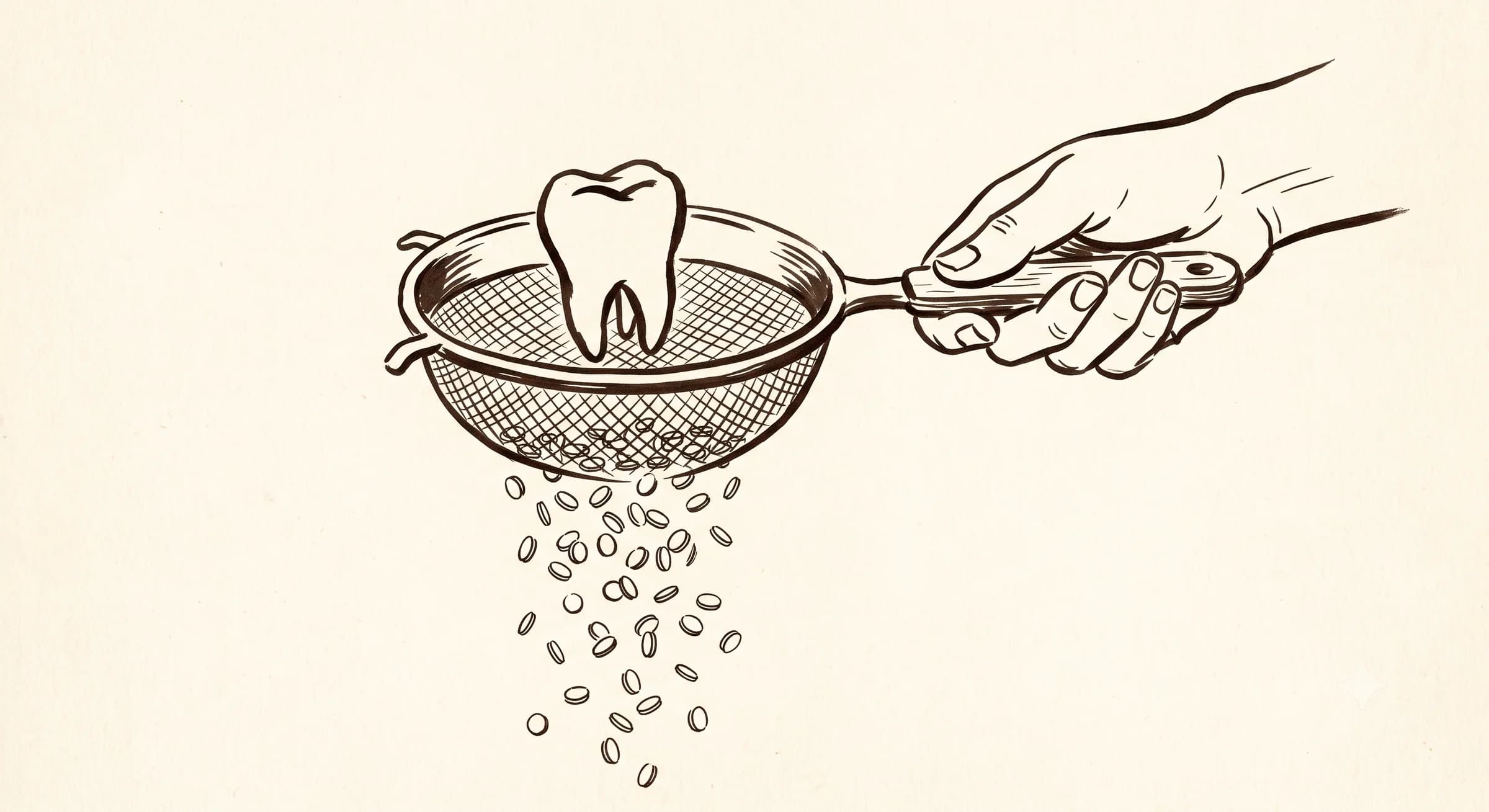
We saw how much this matters on another high-ticket, considered purchase. It was the funnel we built for a UK probate law firm.
We first set the campaign to bid for maximum conversion value, with no conversion history behind it. It spent the budget on a couple of clicks at a cost per click the account could never sustain.
So we switched to maximising clicks. We kept a ruthless negative-keyword list and stayed hyper-targeted on the exact terms for each ad group, so the leads stayed qualified even without conversion data. That produced a much lower and much more controllable cost per click.
Implants sit at the same crossroads. Take control of who you pay to reach first, then let the machine optimise once it has real data to learn from.
Filter three: a treatment page that pre-qualifies
Sending implant clicks to your homepage undoes the work the keywords just did. The page that turns a click into a qualified enquiry is a dedicated treatment page that pre-qualifies for you, so the people who fill the form are already halfway to a yes.
A "single tooth implant [town]" click should land on a page about exactly that, not a general services menu the visitor has to search.
A page that filters well answers three questions before the patient even has to ask them.
Am I a candidate?
Answer it in plain language, so unsuitable cases quietly rule themselves out instead of booking a consultation that goes nowhere.
What does it cost?
Show honest price bands. Hiding the number only attracts the shoppers who will ask for it and then vanish.
Can I afford it?
Show finance clearly. A monthly figure turns a wall into a decision a real patient can actually make.
Honest price bands do more filtering than any clever headline. The bargain-hunter looking for the cheapest arch sees a real range and leaves without costing you a phone call.
The treatment-ready patient sees a clinic being straight with them and trusts it more. You lose the enquiry you never wanted and win confidence with the one you did.
For the wider view of how the page sits inside the whole journey, the lead generation funnel for service businesses walks through each step.
Filter four: call tracking and speed to lead
The last filter is what happens after the form. Two things decide whether a qualified enquiry becomes a case. Whether you can see which ads and keywords produce real conversations, and how fast you call back. Both are usually where the money already spent quietly leaks away.
Call tracking is how you tell a good lead from a bad one at the source. It ties each phone enquiry back to the keyword and ad that created it. So you learn which searches produce booked consultations and which only produce time-wasters, then move budget accordingly.
Without it you are optimising blind, judging a campaign on form-fills instead of on the patients who actually turned up.

Speed is the other half. The evidence here is blunt.
A Harvard Business Review study of 2,241 companies found that contacting a web lead within an hour made a firm nearly seven times more likely to qualify it than waiting just an hour longer (Harvard Business Review, 2011).
21x
Implant patients enquire in the evening and contact several clinics at once. So the practice that calls back first usually wins the case. At Njord Star this is the part we watch hardest on any high-ticket funnel, because a slow callback loses a patient that good targeting already paid to win.
Before you blame the leads, check the front desk
Sometimes the leads are fine and the front desk is leaking them. A treatment-ready patient who never gets a callback looks identical on the report to a tyre-kicker who was never going to book.
So before you conclude the enquiries are junk, follow one all the way through and watch where it actually dies.
This matters because of how lead quality and volume really work. They are not one or the other. They are a dial you turn as you learn.
Early on you want enough volume to see what a good enquiry looks like against a bad one. Once you can tell them apart, you tighten towards quality and your cost per accepted case falls. A campaign that never gets followed up teaches you nothing, because every lead looks bad when none of them get a proper call.
For the full picture on winning the right patients, see how to get more dental implant patients. If you want to sanity-check what implant clicks really cost first, what Google Ads cost in the UK breaks the paid side down.
And for the wider picture beyond implants, the digital marketing guide for UK dentists covers the whole channel mix.
The short version
Tyre-kickers are not bad luck. They are the enquiry your campaign asked for, and you can ask for a better one.
Choose intent-led keywords over broad implant traffic. Add negatives so bargain searches never cost you a click. Send paid traffic to a treatment page that pre-qualifies on candidacy, honest price bands, and finance. Put call tracking behind it so you can tell good enquiries from bad. Call back within minutes, not hours. And before you blame the leads, follow one through end to end to see whether the front desk is the real leak.
If you want to know whether paid search would actually pay for itself in your area before you spend a penny, that is exactly what our Paid Search Validation tool is built to check.