
The Lead Generation Funnel for Service Businesses (What It Actually Looks Like)
· 10 min read
Most funnel advice is written for software companies. Here is what a lead generation funnel really looks like for a solicitor, clinic, or trades business, stage by stage.
Search "lead generation funnel" and almost everything you find was written by a software company, for another software company. Lead scoring. MQLs and SQLs. Nurture sequences with 19 automated emails. Demo bookings for a sales team of 12.
You run a law firm, or a clinic, or a roofing business. You do not have a sales team of 12. You have you, maybe a receptionist, and a phone that needs to ring with the right people on the other end.
The funnel you actually need is simpler than the internet makes it sound. And the part that matters most is the part almost nobody writes about. This is the version for you.
What a lead generation funnel actually is
A lead generation funnel is the path a stranger takes from never having heard of you to becoming someone you can actually do business with. That is the whole idea.
You start with a lot of people who might need what you do. You narrow them down, step by step, to the few who are ready to pay you.
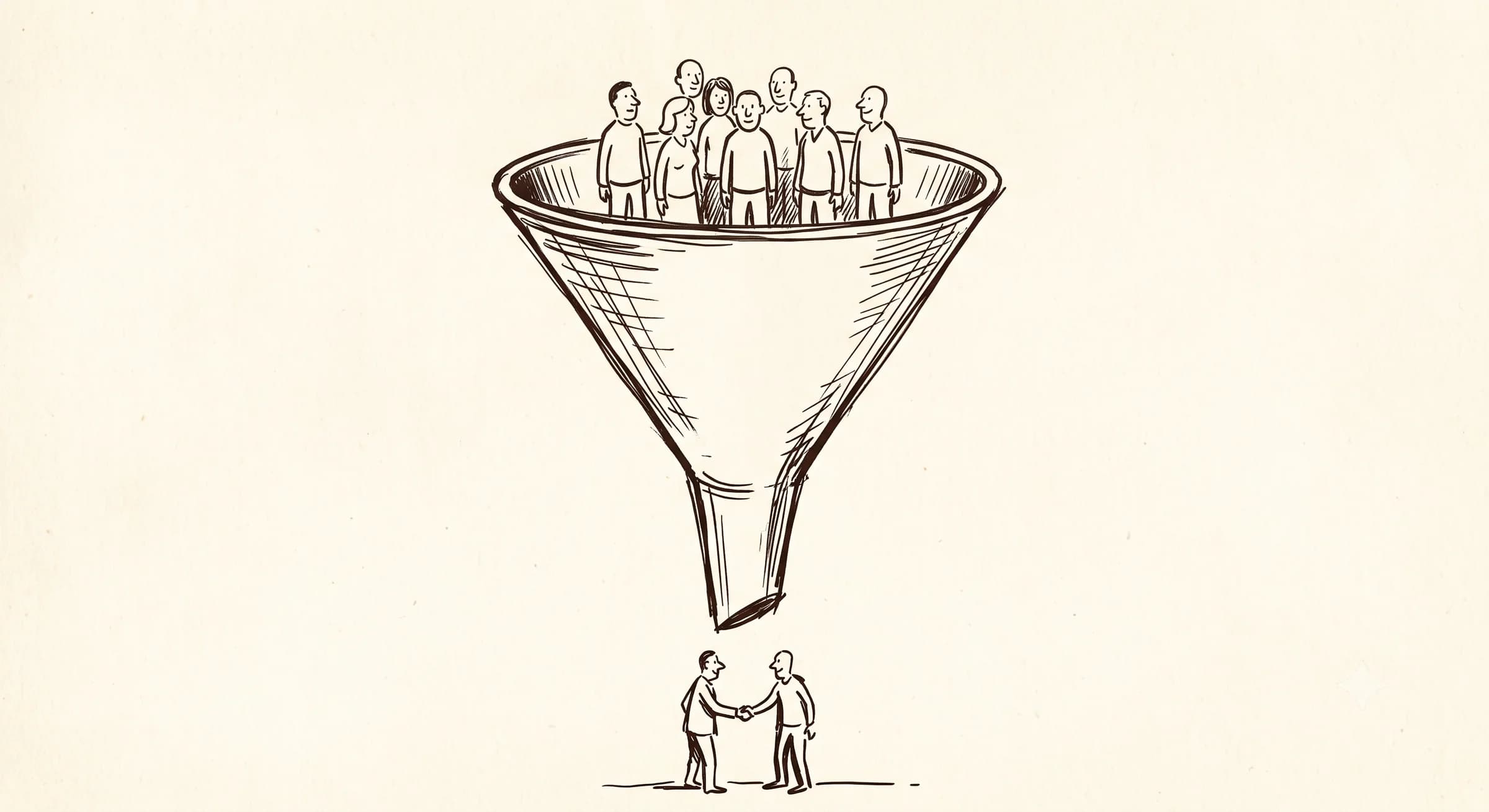
It is called a funnel for the obvious reason. Wide at the top, narrow at the bottom. Lots of attention goes in, a smaller number of real enquiries come out. Your job is to make that journey clear, and to lose as few of the right people as possible on the way down.
One distinction is worth getting straight early, because the two terms get muddled. A lead generation funnel is about turning strangers into enquiries. A sales funnel is what happens after, turning those enquiries into paying clients.
For most service businesses they blur into one motion. We will treat the whole thing end to end here, because pretending they are separate is how leads fall through the gap between them.
That is also why people talk about a lead generation marketing funnel and lead generation in digital marketing as if they are different things. They are not, really. They are the same path described from two angles. Marketing fills the top. Sales closes the bottom.
Why the standard funnel advice does not fit you
Here is the honest part. Most funnel guides are not wrong. They are just built for a different business than yours.
The two models are almost mirror images.
The software company they wrote it for
- Hundreds or thousands of buyers
- Each worth a modest amount
- A long research cycle
- Needs lead scoring, long nurture, a sales pipeline
Your service business
- A handful of clients
- Each worth a great deal
- The decision often happens fast
- Needs four jobs done well, not automation
For the software company, the complexity earns its keep because the volume is enormous.
A service business is the opposite. Someone needs a solicitor this week, not after a three-month evaluation. A patient with a problem wants an appointment, not a whitepaper.
Bolt a software company's funnel onto a service business and you get elaborate machinery built to handle a flood that never comes. Meanwhile the handful of high-value enquiries you do get sit ignored in an inbox.
So forget the 19-email sequences. Your funnel has four jobs, and doing those four jobs well beats any amount of automation.
The four stages, in plain terms
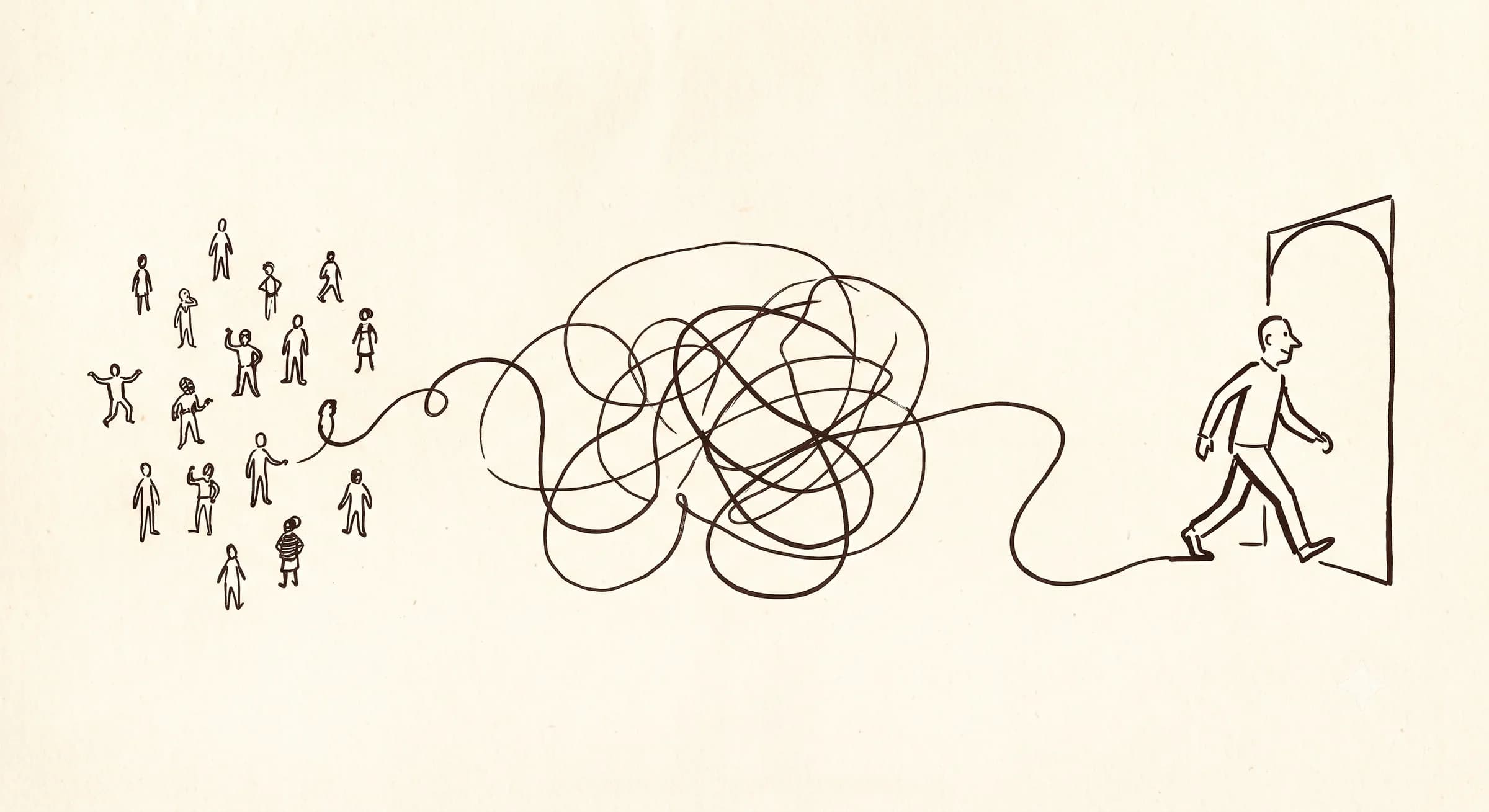
Strip away the jargon and every lead generation funnel does the same four things. Get attention. Capture the contact. Follow up. Convert. That is it.
- 1
Attention
Get in front of people who already need what you do. The best traffic comes from people actively searching, because they have the problem right now. Someone typing "conveyancing solicitor near me" is worth 10 who scrolled past a clever advert. - 2
Capture
Attention is useless if it leaves without telling you who it was. A focused page with one clear job: get the right person to call, fill a short form, or book. Not your homepage with its 14 menu items. This is where most of the money is won or lost, and it is almost entirely in your control. - 3
Follow-up
The enquiry is in. What happens in the next 5 minutes decides more than people believe. This is the leak that quietly costs service businesses more clients than anything else. - 4
Convert
The conversation that turns an enquiry into a client. The consultation, the quote, the first appointment. If the first three stages did their job, this one gets a lot easier.
This is why search-based channels do the heavy lifting for service businesses, and why it is worth reading what that traffic actually costs before you commit a budget. Four stages. No software degree required.
The leak nobody talks about
Ask most business owners where their funnel is failing and they point at the top. Not enough traffic. Not enough leads. So they spend more on ads, pour more in at the wide end, and wonder why it does not help.
There is a related complaint we hear a lot, and it points at the same place. "The leads I get are rubbish. Cold data, time-wasters, people who were never going to buy." Sometimes that is a targeting problem at the top. Far more often it is a follow-up problem in the middle. A genuinely interested enquiry that waits two hours for a call back has gone cold by the time you reach it, and a cold enquiry looks exactly like a bad one. Plenty of "poor quality leads" were good leads that were answered too late.
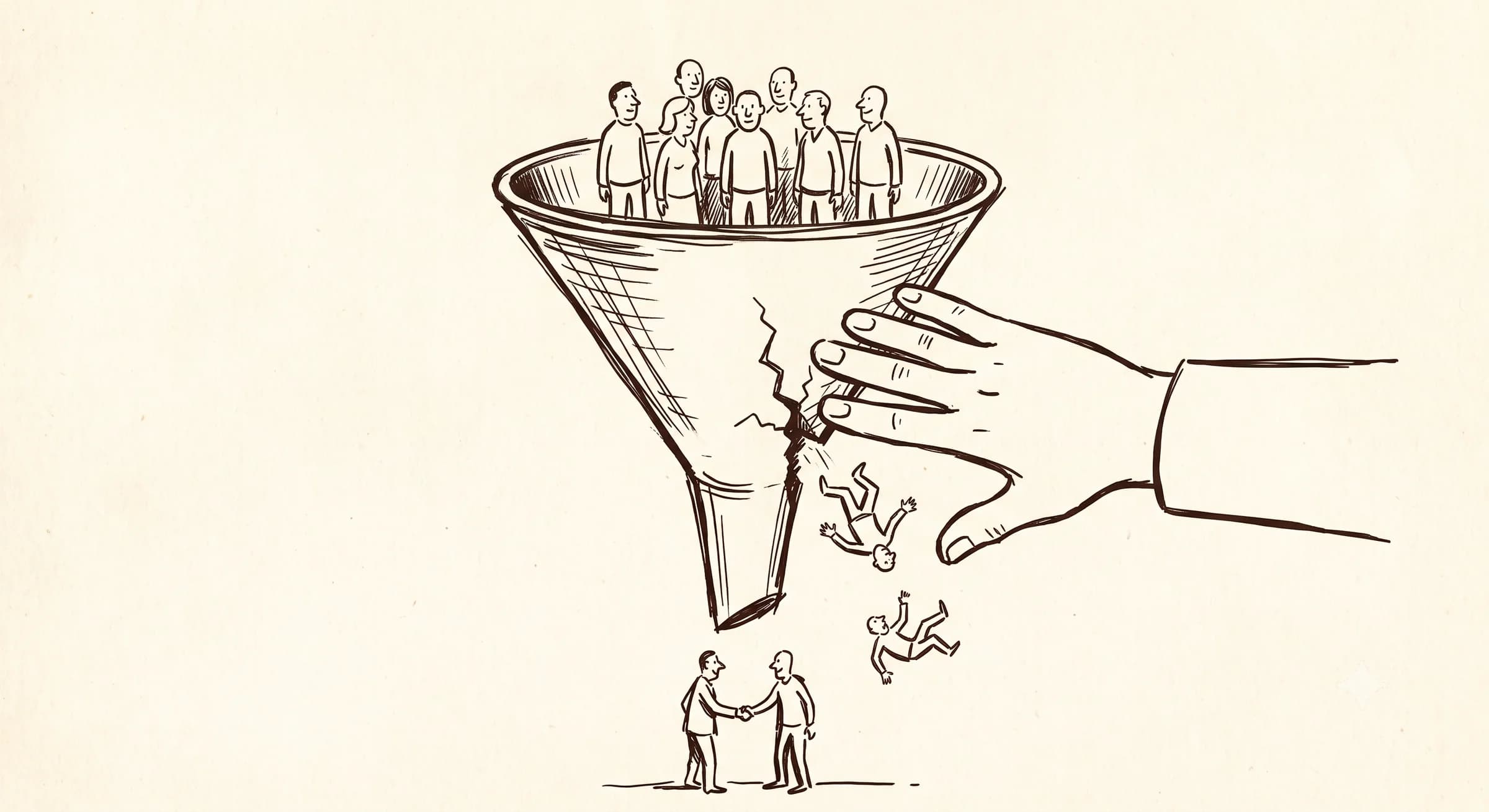
The real leak is usually stage three. Follow-up. Specifically, how fast you respond when an enquiry comes in.
5 minutes
The numbers on this are brutal and consistent. Speed is not a nice-to-have. For an enquiry that just raised its hand, it is most of the game. Your prospect has a problem they want solved now, and they are usually contacting more than one firm. The first real human to call them back has an enormous advantage, almost regardless of who is cheapest or most qualified.
This is the cruel irony of pouring money into the top of the funnel. You win the expensive part, the click and the enquiry, then lose the client because it sat in an inbox over lunch.
You can win the expensive part for money and lose the client for free.
Fixing follow-up costs nothing and often does more than doubling your ad budget.
We learned this the hard way on a UK probate law firm's funnel. The first version asked leads to book and prepay for a consultation straight away. It did not land.
The one lead that converted came from manual follow-up. A real person calling back, not the cold booking.
So we dug into why, and the reason was about response and reassurance. People seeking help with something stressful prefer a phone conversation to waiting on an appointment with someone they have never spoken to and prepaying for it.
We confirmed it by searching the exact terms we were targeting and clicking every competitor ad. They all had one thing in common, a phone number on the page.
So we moved to a tracked callback request. The lead gets the fast human call they actually want, without the tracking breaking the moment they dial a number directly.
The fix was not a bigger budget. It was getting a human onto a fresh enquiry quickly, and routing the enquiry so that could happen.
If you do one thing after reading this, make it this.
The one number that runs the whole funnel
A funnel is not really about stages. It is about economics. The question underneath all of it is simple. What does it cost you to win one client, and what is that client worth?
Get those two numbers and the whole funnel comes into focus. You stop asking "are leads expensive" and start asking "do my numbers work."
It also moves the conversation onto the only metrics that pay you. Not clicks, not impressions, not traffic, but booked calls and clients won.
Those are the numbers a funnel exists to produce, and the only ones worth judging it by. This is the heart of lead generation in digital marketing, and it is where most owners have never done the math.
Work backwards. Decide what a new client is worth to you over the time they stay. Decide what you can happily pay to win one and still profit. Then trace it up the funnel.
- If one in three serious enquiries becomes a client, you need three enquiries per client.
- If your page turns one in 20 visitors into an enquiry, you need 60 visitors per client.
Now you know exactly how much traffic you need and what you can afford to pay for it.
That single calculation tells you whether your funnel is healthy or broken, and where.
- Too few visitors. A stage-one problem. Not enough attention arriving at the top.
- Visitors who do not enquire. A stage-two problem. The capture page is not doing its job.
- Enquiries that do not convert. A stage-three or four problem. Nine times out of ten it traces back to follow-up.
The funnel stops being a vague marketing concept and becomes a set of numbers you can actually fix.
The point that surprises most owners is how much leverage sits in the middle stage. The capture page is the one part almost entirely in your control, and small moves there ripple all the way down. Move the sliders below and see it for yourself.
Interactive · Funnel math
Move the sliders. Watch where the clients come from.
People who land on the page
Visitors who become an enquiry
Enquiries you turn into clients
Same traffic. No extra spend.
Lift your website conversion from 5% to 8% and you win 9 more clients a month, from the exact same visitors.
1,000 monthly visitors at a 5% website conversion rate and a 33% enquiry-to-client rate gives 50 enquiries and 17 clients a month. Lifting the website conversion to 8% gives 9 more clients a month at the same traffic.
What a healthy funnel looks like end to end
Let us put it together for a typical service business. Imagine a small law firm wanting more of one type of work, say will writing.
Stage one, they run search ads on the terms people use when they want a will written, pointed only at their service area. Strangers with real intent start arriving.
Stage two, those clicks land not on the firm's busy homepage but on a single clean page about will writing, with one clear invitation to book a free 15-minute call. A focused page like that might turn one in 15 or 20 visitors into an enquiry, far better than a general homepage ever would.
Stage three, every enquiry triggers an immediate alert, and a real person calls back within the hour, while the prospect still has the firm in mind.
Stage four, that call books the consultation, and the consultation wins the client.
Nothing exotic. No marketing automation suite. Just four stages, each doing its one job, with the follow-up tight.
That is a lead generation funnel that works for a service business, and it is the same shape whether you are a dentist, an accountant, a clinic, or a law firm. The channel and the offer change. The structure does not.
Building it without overcomplicating
The temptation, once you understand the stages, is to build all of it at once and add every tool going. Resist that. The minimum viable funnel is small.
You need one source of qualified traffic, one focused page that captures, one reliable way to follow up fast, and a simple way to see which enquiries turn into clients.
That last part, tracking, is the one most people skip, and the one that makes everything else measurable. Without it you are guessing at every stage. With it you can see exactly where people fall out and fix that one thing.
Start there. One channel, one page, one follow-up rule, basic tracking. Get that loop working and profitable before you add a second channel or a second offer.
A small funnel that converts beats a sprawling one that leaks, every time. If you want to see how the whole thing fits together as a single managed system, that is what we at Njord Star walk through in how it works.
The short version
A lead generation funnel is just the path from stranger to client, narrowed in four steps. Get in front of people who already want what you do. Capture them on one focused page. Follow up fast, while they are still warm. Convert them in a real conversation. Most of the advice online over-engineers the first stage and ignores the third, which is exactly backwards for a service business.
Build the small version, keep the follow-up tight, and measure what turns into actual clients. Do that and the funnel stops being a marketing buzzword and starts being the most predictable part of your business.
The whole funnel works backwards from one number: what a client is worth to you, and what you can therefore afford to spend to win one. Trace that figure up through your conversion rates and it tells you what each stage is allowed to cost, which is how you decide whether the math adds up before you spend anything. The Paid Search Validation tool runs that calculation.