
How Much Do Google Ads Cost in the UK in 2026
· 9 min read
What UK service businesses actually pay for Google Ads in 2026, traced from click to lead to a real monthly budget. No vague ranges.

Most articles answer this question with a range so wide it tells you nothing. "Anywhere from 40p to £6 a click." Thanks. That is the difference between a campaign that prints money and one that quietly drains your account.
The owners who ask us this usually say the same thing first. They do not have tens of thousands to waste. Most have been burned before, or watched a friend get burned. So they want to know what the money actually buys before they spend a penny. Fair. That is exactly the question this answers.
So this is the honest version. What you actually pay for Google Ads in the UK in 2026, traced all the way through. Not just the cost of a click, but the cost of a lead, the cost of a client, and the monthly budget you genuinely need before any of it works. By the end you will be able to do the math for your own business on the back of an envelope.
The core idea
The number you are really asking about is not cost per click
When someone asks how much Google Ads cost, they picture a price per click. That is the wrong number to anchor on. It is the first domino, not the one that matters.
Here is the chain.
- 01Click. You pay for it whether or not it goes anywhere.
- 02Lead. Some clicks become enquiries. Most do not.
- 03Client. Some enquiries become paying clients. This is the only one that pays your bills.
The only number that decides whether Google Ads is worth it is the last one: what it costs you to win a paying client, set against what that client is worth to you.
A £9 click sounds expensive until you learn it brought you a £4,000 matter. A 40p click sounds cheap until you learn none of them ever called. Cost per click is context with no meaning attached. Keep reading and we will attach the meaning.
What a click actually costs in the UK in 2026
Across all UK industries, the average cost per click on the search network is usually put at around £1.95 at the time of writing, June 2026. That headline is close to useless for you, though. You do not advertise in "all industries". You advertise in yours, and yours has its own price.
Be careful with that number, and with every published UK average. There is no UK equivalent of the WordStream benchmark study, which measures 13,474 campaigns but only US ones, in dollars. UK figures are compiled by agencies from a mix of third-party benchmarks and their own client accounts, usually with no sample size attached. So treat them as a rough marker for the month, not a measurement.
The real answer for your business is a 10-minute job. Run your own keywords through Google's Keyword Planner for your area and you will see your actual numbers, not an average.
The spread by sector is enormous. Retail and hospitality enjoy cheap clicks. Professional and legal services pay the most in the country.
| Context | Typical cost per click |
|---|---|
| All UK industries, average | £1.95 |
| Legal services, average | £8.25 to £8.58 |
| Competitive legal terms | £9 to £10 and up |
| "Conveyancing solicitor", central London | £12 |
| Same term, Leeds | £7 |
Legal is the clearest example. Same search, same intent, and the click costs a central London firm nearly double what it costs a firm in Leeds.
Two forces drive that. Competition, because more firms bidding on the same keyword pushes the price up. And commercial value, because Google's auction knows a legal client is worth a lot, so the click that might win one is priced accordingly.
Location matters more than people expect. Greater London consistently runs 15 to 30% higher than the equivalent keyword in the north of England, Scotland, or Wales. If your service area is flexible, where you target is a real lever on cost.
So the honest answer to "what does a click cost" for a UK service business is roughly £1.50 to £5 in most sectors, and £8 or more if you are in law or another high-value professional field. But hold that loosely, because we are about to show why it barely matters on its own.
From clicks to leads: the number that actually bites
Not everyone who clicks gets in touch. They land on your page, and a fraction of them call, fill the form, or book. That fraction is your conversion rate, and it is where most of your money is won or lost.
Say your landing page converts at 5%, which is a solid, realistic figure for a service business with a focused page. That means 20 clicks for every lead. At a £3 click, your cost per lead is £60. At an £8.50 legal click, it is £170.

Now watch what the conversion rate does. Push that page from 5% to 7.5% and you need only 13 or 14 clicks per lead instead of 20. Your cost per lead drops by a third, and you did not touch your bids or your budget. You changed the page.
This is the single most important thing to understand about what Google Ads cost. Half the cost is fixed before you start. The other half is entirely in your hands.
The half you cannot control
- Your industry
- Your competition
- The commercial value Google's auction puts on the click
The half you control completely
- Your landing page
- Your offer
- Your follow-up
- Your tracking
The gap this second column opens up is wider than any bid you will ever place.
3x
The difference is never the click price. It is everything that happens after the click.
For reference, the average cost per lead in UK legal sits around £130. If yours is double that, the problem is almost certainly your page or your tracking, not Google.
If you want to find out which, the eight checks in a PPC audit walk through it in the order that stops you fixing the wrong thing first.
The monthly budget question, answered properly
Here is the figure people actually want. What do I put in per month? You do not pick a budget, you reverse-engineer one from what a client is worth to you. But there is a floor to clear first, and it is worth understanding why it exists rather than treating it as a magic number.
As a rule of thumb, a campaign below roughly £500 a month in ad spend struggles. Google's algorithm never gathers enough data to optimise. You pay for clicks while the system is still guessing, so you get the cost without the learning.
The principle underneath is what matters. Spend enough to gather meaningful data and make educated decisions, even if month one is not yet profitable. The exact floor is yours to set from that logic, not a number to obey.
Above the floor, the right budget is not a number you pick. It is a number you reverse-engineer from your own economics. The math is simple and it is the most useful thing in this article.
Decide what one client is worth to you. Decide how many new clients you want this month. Work backwards through your conversion rate and your cost per lead to the spend that produces them.
A worked example, one step at a time.
- 1
Set what a client is worth
A new client is worth £2,000 to you, and you would happily pay £200 to win one. - 2
Work out cost per lead
At a £4 click and a 5% page conversion rate, your cost per lead is £80. - 3
Work out leads per client
If one in three leads becomes a client, three leads make a client. - 4
Land on cost per client
Three leads at £80 each is a cost per client of £240.
That £240 is above your £200 target. So either the page has to convert better, the click has to be cheaper, or the keyword has to be more qualified. Now you are having the right conversation. Not "is Google Ads expensive", but "do my numbers work, and which lever do I pull".
Play with the same math below. It comes pre-filled with sensible UK figures, so you get a useful answer even if you do not know your own numbers yet. Nudge what a client is worth, your click cost, your page conversion, and the clients you want. It works backwards to your cost per lead, your cost per client, and the monthly spend it takes to hit your target. The closer the inputs are to your real numbers, the sharper the answer.
Interactive · Budget backsolver
Work backwards from the clients you want to the spend it takes
What one new client is worth to you
Typical for your search terms
Clicks that become an enquiry
1 client for every N enquiries
Your monthly target
What it takes
Comfortable£800
Implied monthly spend for 5 clients
- Cost per enquiry
- £40
- Cost per client
- £160
- Value vs cost
- 12.5x
A client worth £2,000 against a £160 cost to win one is comfortable. The budget pays for itself.
At £2 a click and 5% page conversion, an enquiry costs £40 and a client £160. 5 clients a month implies £800 of spend. A client is worth 12.5 times the cost to win one.
Most UK service businesses that are serious about this land somewhere between £1,000 and £5,000 a month in ad spend once they are past the testing phase. But that range is an outcome of the math above, not a starting point. Pick the budget that buys the clients you need at a cost you can live with.
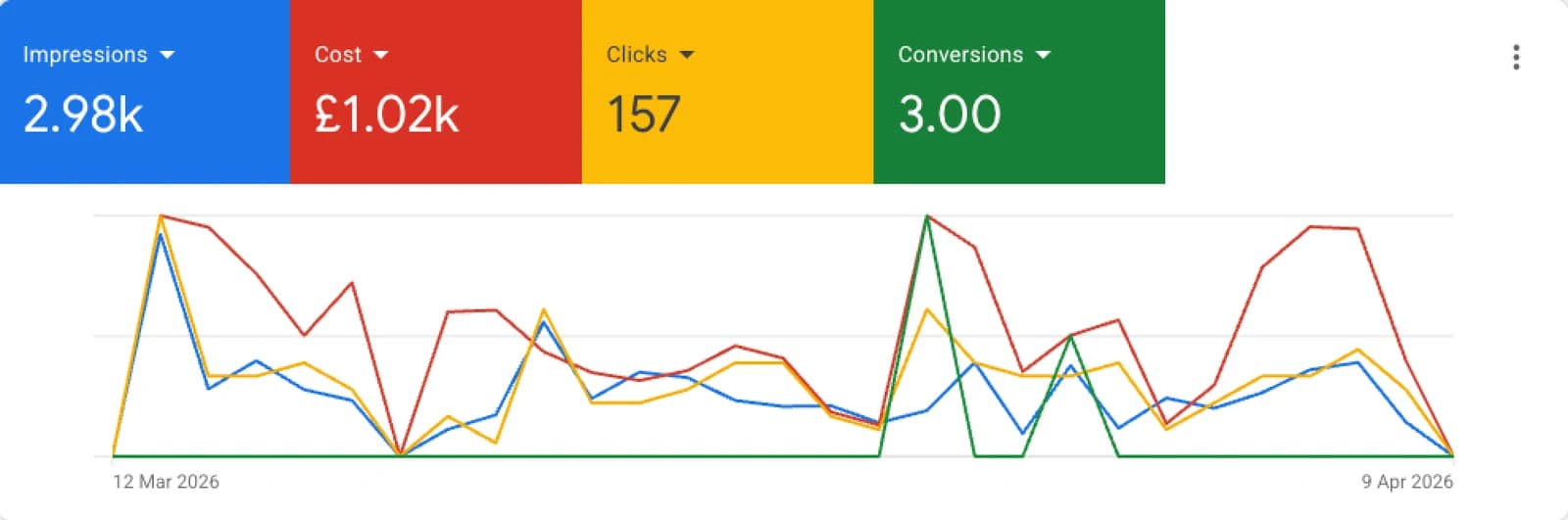
Here is what that looks like with real numbers. One firm we work with started at the lower end of that range, with no prior campaign data to learn from. The first month produced two leads, and one of them became a paying client. A later month, once the funnel had been rebuilt, produced ten leads.
The click price was never the deciding factor. What decided it was the funnel that qualified the lead and the follow-up that turned it into a client.
Two leads is a thin month, and one client is not a pattern. But that is the point worth making: with no history to optimise from, the channel produced a paying client in month one, and the lead volume came later once the funnel was rebuilt. Turning that into steady monthly volume is the next job, not a question of whether the channel can work.
Then there is the cost of management
Everything above is ad spend, the money that goes to Google. If you hire someone to run the campaign, that is a separate cost.
For a business spending £2,000 to £5,000 a month on ads, a competent UK agency typically charges £800 to £1,500 a month to manage it. That should cover campaign build, ongoing optimisation, keyword research, ad copy, bid management, conversion tracking, and reporting. If it does not include conversion tracking, walk away, because without tracking nobody can tell you which of the numbers above are real.
One thing worth checking before you pay anyone to manage an account. Ask what they will report on. If the answer is clicks and impressions, you are being shown activity, not results. The numbers that tell you whether the money worked are leads, booked calls, and clients won. A click count that goes up while your phone stays quiet is the most expensive kind of report there is. For the full list of what a management fee should buy, see what should be in a PPC package.
Is management worth it? Honestly, sometimes not. If your budget is at the £500 floor, a four-figure management fee on top makes the whole thing uneconomic. You are better off learning the basics yourself, or waiting until the budget justifies the help.
If your budget is £3,000 and a good manager can lift your conversion rate or cut your wasted spend by even 20%, they pay for themselves. The fee is only worth it when the account is big enough for their improvements to outweigh their cost. Below that line, be honest with yourself and keep it simple.
When Google Ads is the wrong spend entirely
This article would be dishonest if it pretended Google Ads suits everyone. It does not. Three situations make it the wrong spend, at least for now. If any one of them describes you, put the money elsewhere until it no longer does.
Nobody is searching for what you sell
Google Ads captures existing demand. It does not create it. If your service is a genuinely new category people do not yet search for, your money is better spent elsewhere first.
Your margins cannot absorb the cost per client
A £150 cost per client is fine on a £2,000 matter and ruinous on a £200 one. If the math produces a number your margins cannot carry, do not start. Run the numbers before you run the ads.
You cannot yet measure what happens after the click
If you cannot trace a click through to a lead and a paying client, fix that first. Everything in this article depends on it. Spend a penny before you can measure and you are guessing with real money.
The honest summary
What do Google Ads cost in the UK in 2026? A click costs £1.50 to £5 in most service sectors, and £8 or more in law and high-value professional services. But the click price is the least important number in the whole equation.
What you actually pay for a client depends far more on your landing page, your offer, your follow-up, and your tracking than on the auction. The businesses that think Google Ads is expensive are almost always the ones leaking the cost somewhere after the click and blaming the click.
Work backwards from what a client is worth to you. Set a budget above the £500 floor that buys those clients at a price your margins can carry. Measure everything. Pull the levers you control. Done that way, the question stops being "how much do Google Ads cost" and becomes "how much am I willing to pay for a client I can clearly afford." That is a question with a confident answer.
So the useful first step is not opening an ads account, it is working out that affordable number for your own business: what a client is worth to you, and what you can pay to win one without losing money. Once you have it, the click price stops being frightening and becomes just one input you can check against. The Paid Search Validation runs that calculation.