
How to Get More Dental Implant Patients
· 9 min read
More implant patients is a quality problem, not a volume one. Why chasing lead count fills the diary with tyre-kickers, and how to win treatment-ready patients instead.
To get more dental implant patients, stop chasing lead volume and start winning treatment-ready patients who show up and accept a case. More implant patients is a quality problem, not a quantity one. One arch can be worth £12,000 to £18,000, so a diary full of the wrong enquiries is worse than a handful of the right ones.
That runs against almost every pitch you have heard. Most implant marketing is sold on numbers. Forty new patients a month. So many implant leads a week. Done-for-you enquiries.
It sounds like progress. Then the enquiries turn out to be tyre-kickers who price-shop five clinics and ghost, no-shows who never meant to book, and a dashboard full of clicks with nothing in the diary to show for it.
We have watched owners spend thousands and end up angrier than when they started. Not because the ads did not run, but because nobody asked the only question that matters.
Did any of this turn into a case?
This is how to fix that, and why the goal was wrong from the start.
More implant patients is a quality problem, not a volume one
The reason your implant marketing feels like hard work is that it is aimed at the wrong target. Chasing lead count is exactly what fills the diary with tyre-kickers. The moment the goal becomes more leads, everything downstream optimises for cheap enquiries, and cheap enquiries in implants means price-shoppers.
Reframe the goal to treatment-ready patients who accept a case, and the whole strategy changes.
Volume is the easiest thing in the world to buy. Drop your keywords wider, lead with a price in the ad, strip out anything that makes someone pause, and the lead count climbs.
It looks like a win on the report. It is a loss in the surgery. You now pay your team to phone people who were only ever curious about the cheapest quote in town.
Quality is a decision, not luck.
You decide it with your targeting, your page and your follow-up. A clinic that wins fewer, better enquiries beats one drowning in cheap ones every time, because implants are a considered, high-ticket purchase.
The patient is not impulse-buying a whitening kit. They are choosing who to trust with £15,000 and their face.
This is the same instinct behind any good lead generation funnel. It is not the size of the crowd at the top. It is how well each step filters that crowd down to the people who were always going to say yes.
Count cases, not clicks
The single most useful change you can make is to measure cost per accepted case, not cost per click or even cost per lead. A click tells you someone was curious. A lead tells you they filled a form. An accepted case tells you a patient booked, attended and said yes to treatment.
Only the last one pays your team. So it is the only number worth optimising.
Start from the ticket, because it is what makes implants different.
| Treatment | Typical UK price |
|---|---|
| Single implant | £1,800 to £4,500 (near £2,500 in London) |
| All-on-4 arch, typical | £12,000 to £18,000 |
| Both arches together | £22,000 to £36,000 |
Single-implant figures from Zental (2026). Arch and both-arch figures from Smile London's All-on-4 cost guide (2026). Price guides drift, so check current ones before you quote.
When one patient is worth that much, you can comfortably spend far more to win them than your instinct allows.
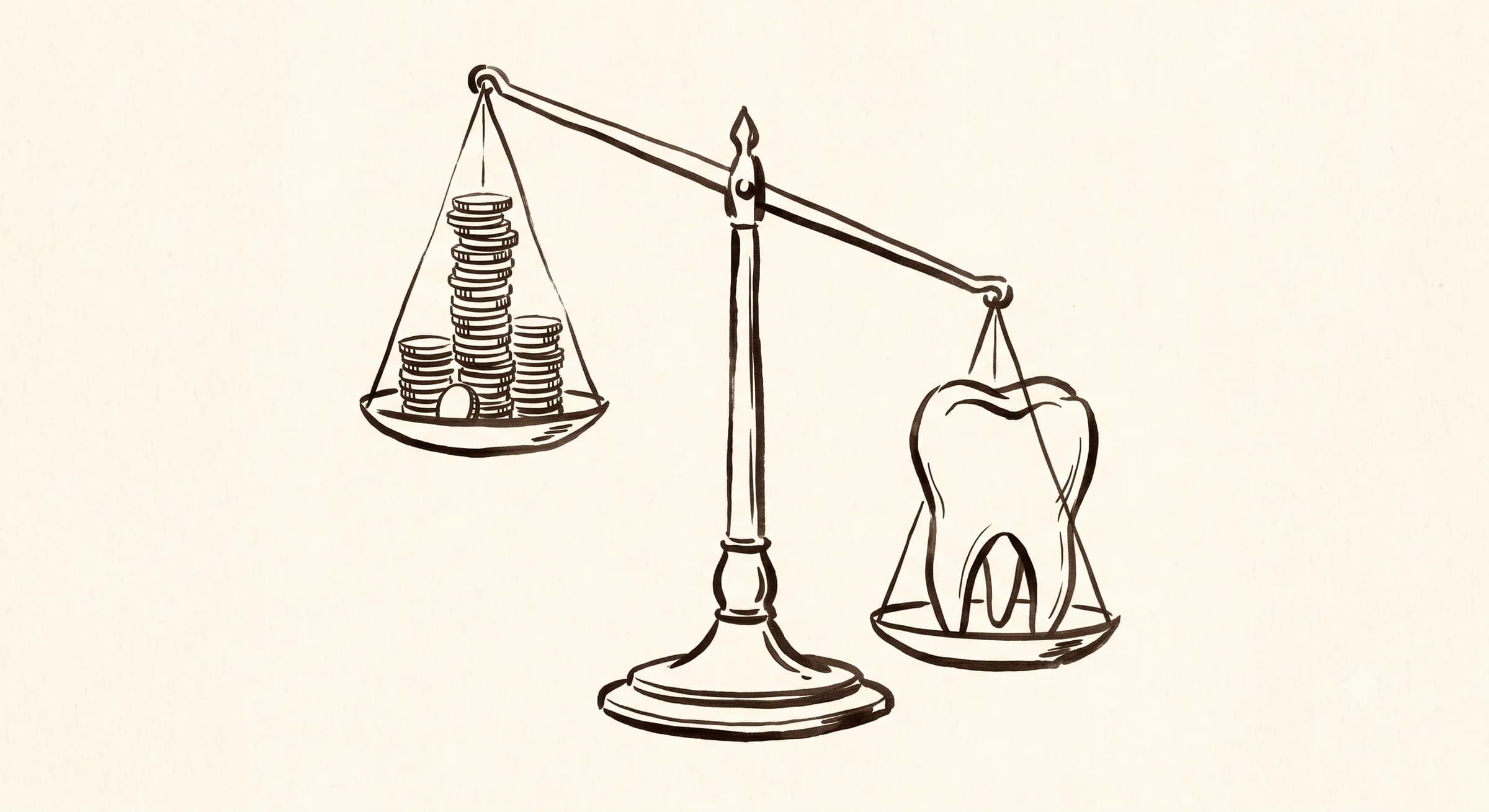
Now put the media cost next to it. In competitive UK cities, implant and cosmetic keywords cost roughly £8 to £25 per click, and central-London implant terms can sit at £10 to £18 (Whitehat SEO, 2026).
Those are live figures that drift, so treat them as a guide and check your own area in Google Keyword Planner. A run of clicks becomes an enquiry, and how many clicks that takes is worth measuring in your own account rather than borrowing from someone else's blog.
Here is why counting cases changes the decision. Say enquiries cost you £150 each, and one in five patients who attend accepts a £12,000 arch.
Ten enquiries is £1,500. If two attend and one accepts, that is one case worth £12,000 from £1,500 of spend.
The cost per lead looks scary until you divide by cases, not clicks. A cheaper lead that never accepts is the expensive one.
Interactive · Cost per accepted case
Work out what one accepted implant case really costs you
What one implant enquiry costs you to win
Enquiries that book and attend a consult
Attended consults that say yes to treatment
What one implant case is worth to you
Per accepted case
Comfortable£1,500
Cost per accepted implant case
- Cost per consultation
- £300
- Enquiries per case
- 10
- Value vs cost
- 8.0x
A case worth £12,000 for a £1,500 cost to win one pays back 8.0 times over. The cost per enquiry looks scary until you divide by cases, not clicks.
At £150 per enquiry, 50% booking a consult and 20% accepting, you burn 10 enquiries per accepted case, so a case costs £1,500. A £12,000 case covers that 8.0 times over.
Why your implant ads attract tyre-kickers
Price-shoppers are not bad luck. The enquiry does what the campaign asked it to. Broad keywords like "dental implants" pull in researchers and bargain-hunters, and a price-led ad promises the cheapest quote, so the cheapest-quote crowd is exactly who clicks.
The fix starts before the click, at the keyword level, and it runs all the way through to how fast you call back. We have written that filter up in full: how to get qualified implant leads walks through all four screens.
The landing page is where you pre-qualify
Sending implant traffic to your homepage wastes it. The page that converts implant enquiries is a dedicated treatment page that does the pre-qualifying for you, so the people who fill the form are already halfway to a yes.
Send "dental implants [town]" clicks to a page about implants specifically, not a general "our services" list where the visitor has to hunt.
A page that filters well answers three questions before the patient asks. Am I a candidate, what does it cost, and can I afford it. The qualified-leads guide sets out how to answer each one so the wrong cases rule themselves out.
We learned how much the page carries the load the hard way, on another high-ticket funnel for a UK probate law firm. On one campaign, around 150 clicks produced barely a handful who even started the enquiry form, let alone finished it.
The traffic was there. The page and the first thing we asked for were not compelling enough to convert it.
Getting the click is the cheap part.
If the page and the first ask do not match what the visitor actually wants, the spend is gone no matter how good the targeting was. Implants are no different, only the ticket is bigger.
Speed to lead and the treatment-coordinator gap
The fastest win most implant clinics are sitting on is follow-up speed. Implant patients often enquire in the evening, and they are usually contacting more than one clinic.
The practice that calls back within minutes wins the case. A calm treatment coordinator who answers the candidacy and cost questions and books the consultation beats the clinic that waits until tomorrow.
This is where a static contact form and a "we will get back to you within 24 hours" quietly costs you the most. That delay does not just slow the pipeline. It actively pushes the patient to keep shopping while they wait.
By the time you call, someone else has already booked them in.
On that same probate funnel, the pattern was identical. Our first version asked people to book and prepay for a consultation with someone they had never spoken to, and it did not land.
The one lead that converted came from manual follow-up, a call, not the cold booking. We confirmed why by searching the exact terms we were targeting and clicking every competitor ad. They had one thing in common, a phone number front and centre.
People buying something big and personal want to talk to a human first.
So we moved to a fast, tracked callback. Implant patients behave the same way. The consultation is a conversation, not a checkout, and the clinic that offers the conversation soonest usually gets the case.
At Njord Star this is the part we watch hardest on any high-ticket client, because it is where the money already spent either turns into a patient or leaks away.
You can fix targeting and pages all you like. If the callback is slow, the case is gone.
Local visibility, built for implants
Alongside paid search, the highest-return free channel is local visibility. Most implant patients start with a local search, and Google answers with a map of three clinics above everything else. Getting into that map pack, and ranking under it, is how you earn implant enquiries month after month at no ongoing media cost.
The unglamorous work is what moves it.
- Your Google Business Profile. Complete and optimised, with real photos, your implant services listed, and correct hours.
- A steady review habit. Ask happy implant patients for Google reviews and reply to every one. Trust does more heavy lifting on a £15,000 decision than on a check-up.
- A treatment-and-location page. A real page for dental implants in your town, the same one that pre-qualifies your paid traffic, now earning organic clicks too.
Paid search fills the diary this month. Local visibility lowers the cost of filling it next year.
Run them together and your blended cost per accepted case falls over time, because a growing share of your enquiries arrive for free.
For the paid side of that picture, the true cost of Google Ads in the UK breaks the numbers down further.
For the wider picture beyond implants, the digital marketing guide for UK dentists covers how the same decisions play out across every treatment a practice markets.
What to watch when an agency promises you implant leads
Be wary of anyone selling you implant marketing on lead count alone. A promise of a fixed number of implant leads a month, on a long lock-in contract, reported in clicks and impressions, is a promise to hit a vanity number, not to fill your surgery with accepted cases.
It is the exact pattern that leaves owners thousands down with nothing to show for it.
The tell is the language.
An agency that thinks in leads
- Talks about volume, dashboards and reach
- Reports clicks and impressions
- Needs a year-long lock-in to keep you
- Goes quiet when you ask how many patients booked
An agency that thinks in cases
- Talks about cost per accepted case
- Wants call tracking to hear what happens to your leads
- Has no problem telling you if your front desk is leaking
- Earns your stay month to month, no lock-in needed
The full set of warning signs, and the six-month pattern behind them, is in the signs a dental marketing agency will burn you.
The short version
More implant patients is not a volume problem. It is a quality problem, and you solve it by aiming the whole system at treatment-ready patients instead of cheap enquiries.
Measure cost per accepted case, not per click. Use intent-led keywords and negatives so tyre-kickers screen themselves out.
Send paid clicks to a treatment page that pre-qualifies on candidacy, cost and finance. Call back within minutes with a real treatment coordinator.
Build the map pack and reviews so free enquiries grow over time. And judge any agency on cases, not on a lead-count promise.
If you want to know whether paid search would actually pay for itself in your area before you spend a penny, that is what our Paid Search Validation tool is built to check.