
What Should Be in a PPC Package
· 13 min read
A practitioner's breakdown of what belongs in a PPC package, what it should cost, and the questions that separate a real one from a list of tasks.
Open five PPC package pages and you will read the same list five times. Keyword research, ad copy, bid management, monthly reporting. Swap the logos and nobody would notice.
Every one of those lists is accurate. None of them tells you whether the money will work.
What decides that is what the package does when your account turns out to be the awkward one. Every agency runs a process. The part worth paying for is what happens on the day you fall outside it.
What a PPC package includes
A PPC package is a fixed monthly scope of paid search work sold at a fixed monthly price. The common core is account setup, keyword research, ad writing, bid management, negative keyword work, conversion tracking and reporting. Beyond that core, packages diverge sharply, and the divergence is where your money either works or quietly leaks.
Paid search is the biggest single channel in UK digital advertising, which is why so many agencies sell a packaged version of it. IAB UK's Digital Adspend report for the first half of 2025 put search at £8.3bn over those six months, a 44% share of all UK digital ad spend.
Here is the standard core, and what a thin version of each looks like in practice.
| Line item | What it should mean | What a thin version looks like |
|---|---|---|
| Account setup | Campaign structure, location targeting, ad scheduling and tracking built around your service | A template structure copied across from another client |
| Keyword research | The words buyers actually type, checked against real search terms after launch | A one-off list pulled from a tool at the start and never revisited |
| Ad writing | Ads that match what the searcher asked for, tested against each other over time | Three ads written once and left running for a year |
| Bid management | A bidding strategy chosen for your budget and conversion volume | Smart bidding switched on and left alone |
| Negative keywords | A list that grows every month from the search terms report | A starter list added at setup |
| Conversion tracking | Every enquiry route tracked, tested, and owned by a named person | A tag fired once and never validated |
| Reporting | What happened, what it means, what changes next | A dashboard export with clicks and impressions |
Read that right-hand column again. Not one of those thin versions would show up as a missing deliverable on an invoice. Every one of them ticks the box.
A package is a process someone has productised
A PPC package is a standard operating procedure with a price on it. An agency works out a repeatable process, runs it across many accounts, and prices it so the process pays for itself at volume. That is the whole model, and no package page will ever say so, because they are all selling one.
There is nothing wrong with that. It is how a small business gets paid search expertise for a few hundred pounds a month instead of the cost of hiring someone. The economics only work because the same process runs on everyone.
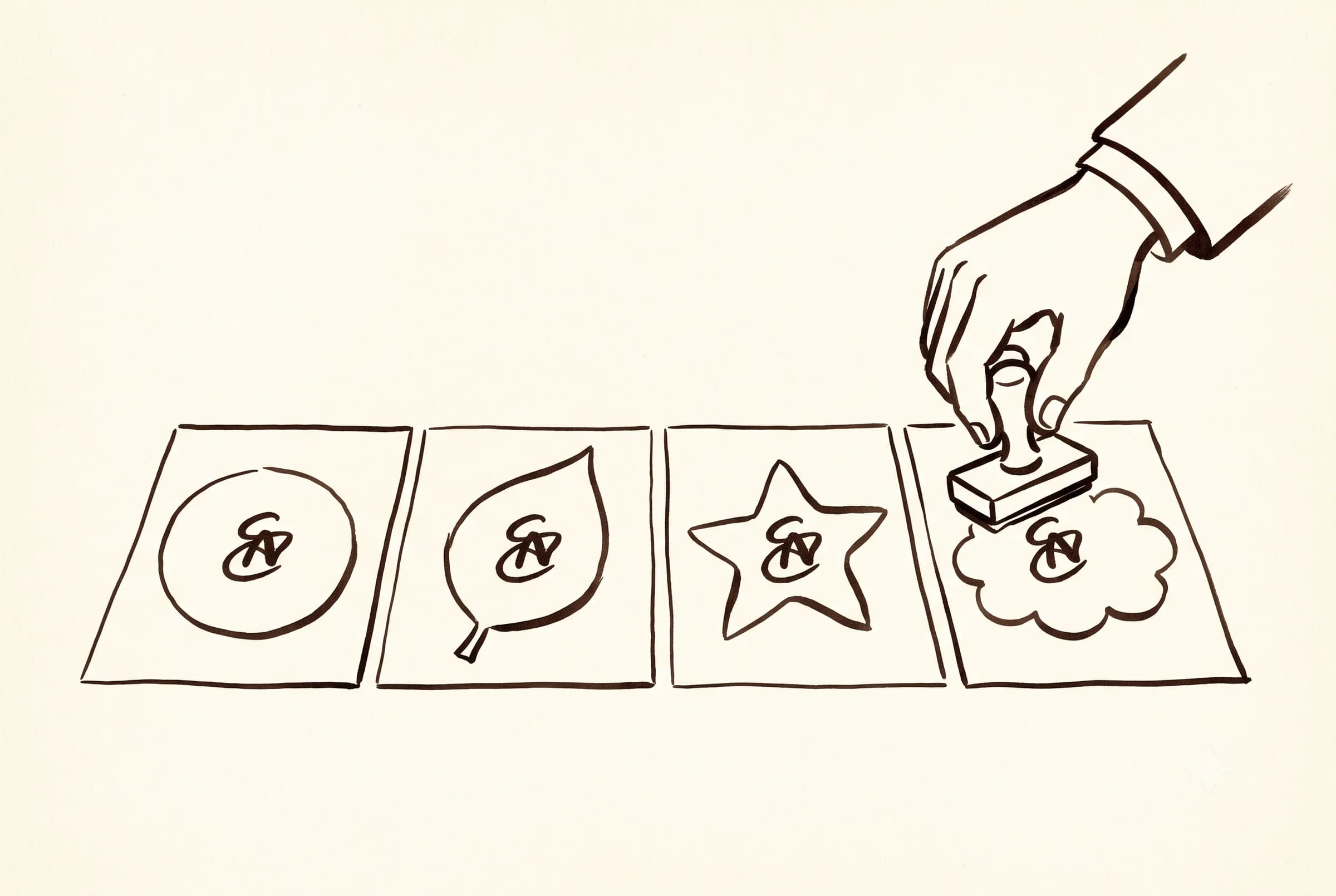
A standardised process fits a large enough share of accounts to keep the agency in business. The accounts it does not fit get the same process anyway. Nobody is being dishonest. The process has no branch for your situation, so it does the standard thing and calls the result normal.
The cheaper the package, the more it has to be one size fits all. That is not a flaw in the pricing, it is the pricing.
You can usually work out in advance whether you are one of the awkward ones. A sales cycle measured in months. A service people only buy in an emergency, at three in the morning. Half your enquiries arriving as phone calls nobody logs. A seasonal trade that does most of its year in eight weeks.
None of those are exotic. They are just outside the shape the process was built around.
So ask what this agency does when your account is one of them. Then listen for whether the answer contains a mechanism or a reassurance. Only one of those can be held to later.
Ad spend is not part of the package
Ad spend and the management fee are two different pots of money. The spend goes to Google, usually billed straight to your own card. The fee goes to the agency for the work. This is the most common misunderstanding in paid search buying, and it produces more bad surprises than any other line in a proposal.
Insist that any proposal you receive quotes the two as separate lines. The fee buys the work, the spend buys the clicks, and one blended number makes it impossible to judge either.
A vague answer here means somebody gets surprised later. The surprise arrives as an invoice, or as a campaign that quietly runs out of money on the 19th.
Before you argue about the fee, size the spend. A 2026 benchmark published by UK agency Visionary Marketing, built from 240 managed accounts and £4.7m of spend between March 2025 and February 2026, puts the average UK search click at £3.42. The service categories most people reading this sit in run well above that.
| Category | Value |
|---|---|
| All industries | 3.42 |
| Home services | 5.42 |
| Healthcare | 6.94 |
| Legal | 18.26 |
Handle the legal figure with some care, because it rests on only eight accounts. Treat the whole chart as a shape, since one agency's book of clients is not the whole market.
The shape is the part that matters. In a high-value service category, 100 clicks is a serious amount of money before a single person has enquired. At the legal end of that chart, 100 clicks costs £1,826. That is most of a small firm's monthly budget gone on one afternoon of traffic, and 100 clicks is not many clicks.
For your own trade and your own postcode, Google's Keyword Planner will give you a closer number than any benchmark table, because it quotes the live auction rather than somebody else's average.
A click price on its own still will not tell you whether paid search works for your business. That depends on what one client is worth to you and how many more you could actually handle. The Paid Search Validation pulls the market data for your service in the areas you serve, then runs it against those two numbers of yours. It takes about two minutes and it will tell you if the answer is no.
What is usually not in the package
Four things sit outside most standard PPC packages, and each one can decide whether the campaign works. Landing pages, the initial conversion tracking build, everything beyond Google Search, and what happens to an enquiry after it arrives. Ad spend is the famous omission. These four are the quiet ones.
Landing pages
Most packages cover the ads and stop at the click. The page the traffic lands on stays your responsibility. Some agencies give recommendations, fewer will build or change anything, and the ones that do usually price it separately.
Getting the click is the cheap part. A package that ends at the click has handed the expensive part back to you.
The conversion tracking build
Ongoing tracking is normally in scope. The initial build often is not, especially anything involving a CRM, offline conversions or a booking system, which tends to get quoted as a one-off project.
Ask which it is. An account running without honest tracking is optimising towards a number that is not real.
Everything beyond Google Search
A package sold as PPC management often means Google Search only. Shopping, video, Performance Max, Microsoft Ads and paid social each tend to come with their own scope and their own fee.
A broad platform list in a proposal is worth checking twice. It is far easier to sell a package covering six platforms than to run six platforms well.
What happens to the enquiry
Almost no PPC package includes follow-up, call handling, or anything that turns a lead into a booked job. That work sits with you.
It is also where a lot of the real loss happens. Plenty of campaigns look broken at the ad level and are broken at the phone. The ad worked, the click got paid for, and nobody picked up.
How PPC packages are priced
Clutch's PPC pricing guide, updated August 2026, names four models in common use. A flat fee, a percentage of ad spend, performance-based pricing, and a hybrid that mixes them. Each one moves the risk somewhere different, and each one pays the agency for something slightly different.
The same guide bands UK PPC agencies at $50 to $99 an hour, roughly half what it bands US agencies at. Clutch reports in dollars, so read that as a position in the global market rather than a rate card.
In the UK, published agency pricing at the time of writing, August 2026, most often quotes either a flat monthly retainer or a percentage of spend between 10% and 20%. That range drifts, so treat it as a starting point and get two or three real quotes before you judge any one of them.
| Model | How it works | Risk sits with | Incentive |
|---|---|---|---|
| Flat monthly fee | Fixed price, fixed scope | Shared, tilting to you as the fee rises | Low |
| Percentage of ad spend | The fee scales with your spend | Mostly you | Low |
| Performance-based | Paid per lead or per sale | Mostly the agency | High |
| Hybrid | Base fee plus a performance element | Shared, tilting to the agency | High |
The incentive column is the one to sit with. A flat fee and a percentage of spend both pay the same whether your results climb or flatten. A flat fee rewards doing enough to keep the account. A percentage rewards recommending a bigger budget, because the fee rises with it.
The two performance models pay the agency out of the outcome, so the pull is towards improvement. The catch is that they reward volume over quality unless a good lead is defined in writing. A hybrid buys you that alignment at the price of a more complicated agreement.
Keep all of that in proportion. The pricing model sets where the risk sits and how hard the agency is pulled towards improving. That is all it does. It is one input into how risky an engagement is, not the whole of it. A track record in work like yours, case studies with numbers you are allowed to question, and reviews from named clients rather than initials will tell you more about your odds than the fee structure ever will.
That does not make a percentage wrong. It suits an account you expect to scale, because the agency is paid more for managing more. A flat fee suits a stable budget and makes your own forecasting simple.
Pick the one that matches how much your budget is likely to move over the next year. Then say the incentive out loud when you agree it. An agency that flinches at that conversation has told you something useful for free.
The four line items that decide whether a package is real
Most of a package list is table stakes. Four things are not. Who owns conversion tracking, how often somebody reads the search terms report, what the monthly report is for, and who sits in the account day to day. These four separate two packages far more reliably than price does.
Who owns conversion tracking
Tracking is the number every other decision rests on. Ask who sets it up, who validates it after launch, and who fixes it when it breaks. A package that treats tracking as a one-off setup task is a package that will report confidently on numbers nobody has checked.
How often search terms get reviewed
Keyword research happens once. Search terms are what people typed, and they arrive every day. A package that reviews them monthly finds the waste. One that reviewed them at setup is paying for clicks nobody has looked at.
What the report is for
A report should say what happened, what it means, and what changes next. The middle part is where an agency either has a point of view or does not. A report that opens with impressions and never names a decision is an activity log.
Who actually works on the account
Ask for the name and the seniority of the person in the account, not the person on the call. The gap between who sells the package and who runs it is the single biggest quality variable in agency paid search.
The search terms one is the easiest to check yourself, and the most uncomfortable. Do it before you speak to another agency.
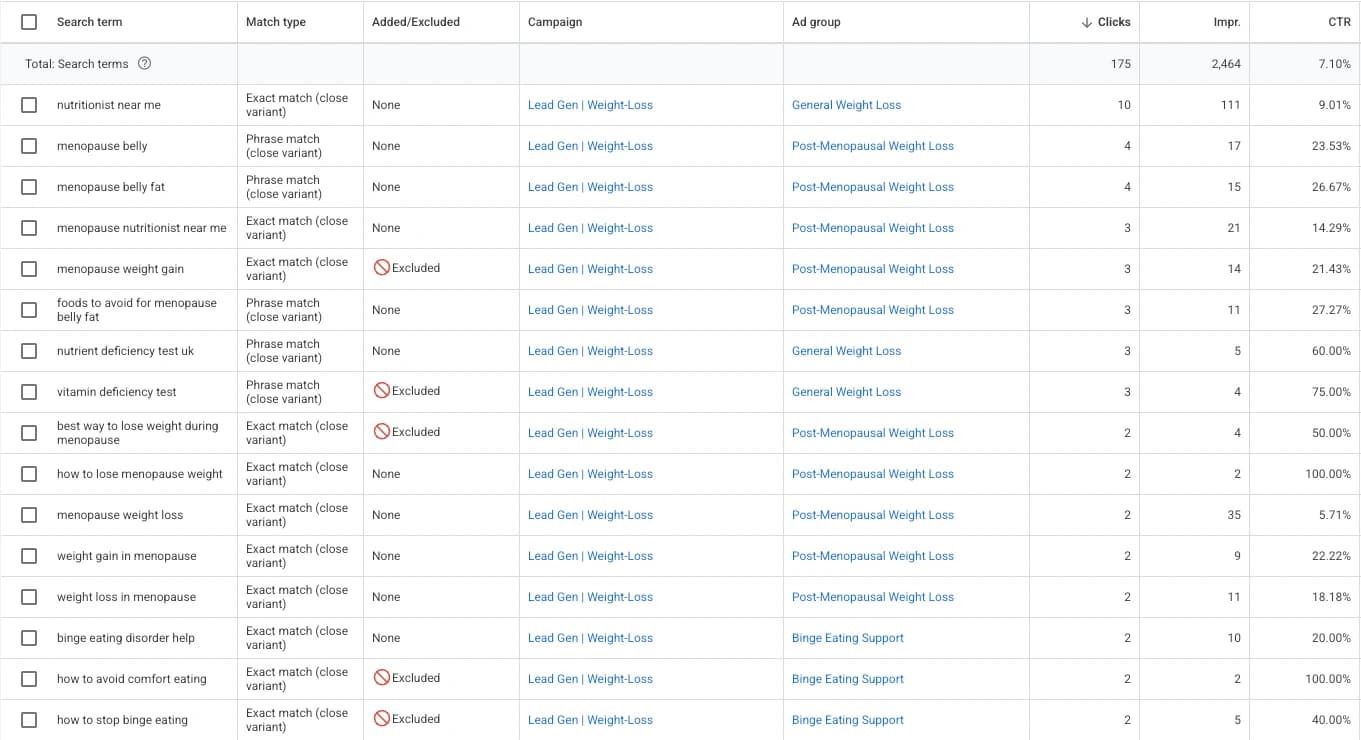
In Google Ads, open Campaigns, then Insights and reports, then Search terms. Set the date range to the last 30 days and sort by cost, highest first.
Every row is a query somebody typed and a click somebody paid for. Near the top you will find things you would never have chosen to bid on.
That is not a failure. Odd queries arrive in every account, because match types are loose by design and Google is not paid to be strict on your behalf. The report is where you catch them. Rows marked excluded are the ones somebody has already turned into a negative keyword, which is the whole job made visible.
Which is why the question is not whether junk shows up. It is whether anybody opened the report this month.
Reporting is the easiest of the four to fake and the easiest to check. Every weekly report Njord Star sends carries the same three things. What happened, what we think it means, and what we are doing next.
The first part any dashboard can produce. The second is the one that costs something, because interpreting a number means committing to a reading of it that could turn out to be wrong. The third forces a decision instead of an observation.
Ask any agency you are considering for a real weekly report with the client details stripped out. If it opens with impressions and never names a decision, you are being shown motion.
What should happen when the ads do not perform
A good agency has a named order of investigation for a bad month. Check the tracking is honest, check the search terms, check the landing page, then check what happens to an enquiry after it arrives. Every package describes what happens when things go to plan. Very few describe what happens when they do not.

Spend an hour reading what business owners say about their agencies in public forums and a pattern shows up. The complaints are almost never about a missing deliverable.
They are about a change that was briefed, confirmed as done, and found undone a month later. About bad news that arrived with a silver lining attached instead of an owner. About a new channel recommended before the current one had been made to work.
Put the question plainly. When the ads do not produce, what is your process. A strong answer is a sequence you could write down afterwards. A weak one sounds like more budget, a new platform, or a promise to keep optimising.
The most useful thing an agency ever tells you is that the problem is not the ads. If a package only ever reports on what the agency controls, you will keep buying traffic to fix a leak in your own front office.
How to compare two packages side by side
Compare in this order. Fit first, then what the package changes rather than maintains, then the four line items, then a real report from each, then where the contract puts the risk. Price comes last. Two packages at the same price can differ enormously in what they do.
- 1
Start with fit, not price
Does this agency work with businesses that look like yours, at budgets that look like yours. A brilliant process built for ecommerce will not serve a service business selling one high-value job at a time. - 2
Separate strategy from upkeep
Split the deliverable list into two piles. Things that keep the account running, and things that change its direction. If the second pile is empty, you are buying maintenance. - 3
Interrogate the four line items
Tracking ownership, search term reviews, what the report is for, and who is actually in the account. Ask each one out loud and write down what you get back. - 4
Read a real report from each
An anonymised one from a live account, not a sample template. Two minutes of reading tells you more than an hour on a sales call. - 5
Check where the risk sits
Contract length, notice period, and whether anything ties the fee to an outcome. Be wary of a 12-month commitment agreed before a single click has been bought on your behalf.
What you should expect to pay
There is no single right number, and any article that hands you one is guessing at your margins. Start from what a client is worth to you rather than from what an agency charges. Work out the profit on one won client, then the clicks it takes to produce one, and the ad spend behind a client falls out of it.
Use your own conversion rate if you have it, and a cautious guess if you do not. The management fee only makes sense as a fraction of a number that already works. If the spend math does not clear on its own, no package price fixes it. Our breakdown of what Google Ads actually cost in the UK walks that calculation through with real figures.
Two practical guardrails. A fee that costs more than the ad spend it manages is hard to justify on a small account. A fee low enough to look like a bargain usually buys the standard process and nothing shaped around your business.
Neither is automatically wrong. Both should be a decision rather than a surprise.
Be honest about scale too. If your budget can only ever fund a handful of conversions a month, a package promising sophisticated bidding optimisation is selling something the account will never have the data to do.
There is a budget floor below which no package is the right answer. At the legal click price from that chart, £300 a month buys 16 clicks. No amount of management skill turns 16 clicks into a pattern worth acting on.
The right package for a small budget is a tighter one, run by someone willing to tell you when the budget itself is the problem.
The short version
Every PPC package sells you roughly the same list, so stop reading the list. Read the process behind it. Who owns the tracking. How often somebody opens the search terms report. Whether the monthly report names a decision. What the agency does on the month the numbers go the wrong way.
Then get the ad spend split written down before anyone signs. That one sentence in an agreement prevents more bad months than any deliverable on the page.
And if an agency cannot answer those four questions about its own process without going away to check, you are paying for the box, not what is in it.